Section 4
Common Lawn Signals — Visual Guide
A quick-reference chart linking what you see above ground to what is happening in the soil below.
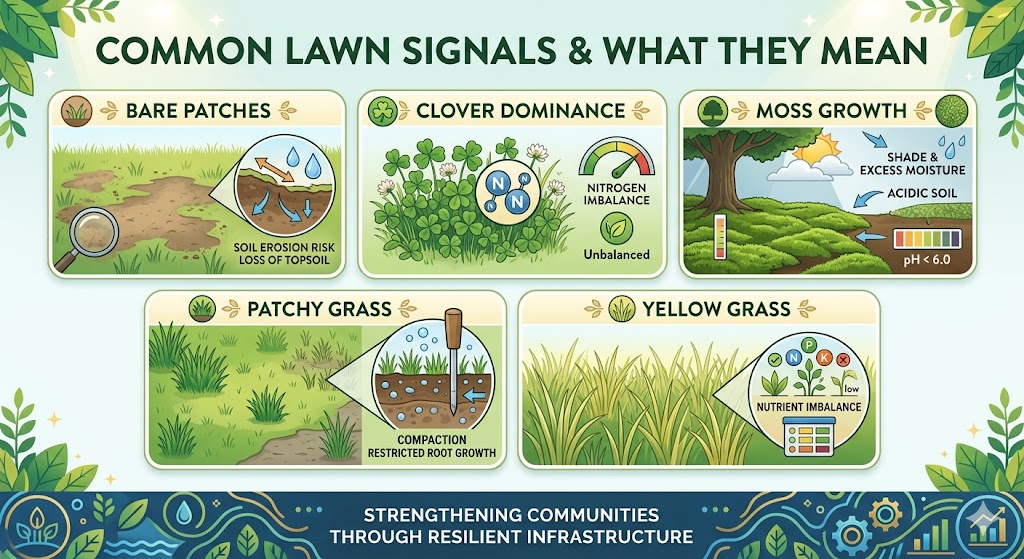
📷 SoilMend.org — Common Lawn Signals Infographic
↓ Download Image
Every bare patch, moss cluster, or clover patch is a message from the soil below. This library helps you decode the signals — and restore health from the ground up.
Match what you see in your yard to the ecological story happening beneath the surface.
Every visual signal in your lawn is a message from the soil below. Bare patches, moss, clover, yellowing — these are not failures to suppress but symptoms to understand. This library translates what you see into what it means for the living ecosystem underfoot. Click any signal to read the full ecological story.
Restoring the lawn from the roots up — the right action at the right time of year.
Soil microbes, roots, and grass plants all operate on seasonal cycles. Working with these cycles rather than against them is the single most important principle of low-intervention lawn care. Each season has a primary goal — and a small set of high-impact actions.
Goal: Stimulate microbial activity and repair winter damage.
If the soil feels like a brick after snow melts, use a core aerator to let the soil "breathe" after winter compaction. Aeration opens pathways for air, water, and microbial movement — the first step in waking up a dormant soil ecosystem.
Apply a ¼-inch layer of high-quality compost. This introduces the "livestock" (microbes) that will process nutrients all summer. Even a thin layer dramatically increases biological activity by mid-spring.
Fill in bare patches early to out-compete opportunistic spring weeds. Perennial ryegrass germinates in 5–7 days and quickly stabilizes exposed soil before weeds can establish a foothold.
Goal: Protect the soil from heat stress and maintain moisture.
Set your mower to its highest setting (3.5–4 inches). Taller grass shades the soil, keeping it cooler and preventing the "baking" that kills surface microbes — the living engine of your lawn's health.
Shift from "sprinkles" to "soaks." Aim for 1 inch of water per week in a single session. This forces roots to dive deep into the subsoil to find moisture — building the drought resilience that shallow watering never can.
Never bag your clippings. Grass clippings are 80% water and 4% nitrogen — essentially free, slow-release organic fertilizer. Returning them feeds the soil microbes that your lawn depends on all season.
Goal: Deep root development and carbon storage for winter.
The best time to test pH. If your soil is too acidic (a sign of moss dominance), apply lime now so it can break down slowly over winter and be ready for spring. Results guide all your next-year decisions.
Don't rake all your leaves — mow over them until they are tiny fragments. Leaf mulch provides the carbon that soil fungi need to survive winter. Fungi are the underground transport network that feeds your grass roots.
Apply a slow-release organic meal (like alfalfa or kelp) to give roots one last meal before dormancy. This feeds the soil biology, not just the plant — ensuring a robust microbial community survives through winter.
Goal: Minimize physical disturbance and plan ahead.
Walking on frozen or waterlogged dormant grass can crush the "crown" of the plant — the growing point — and compact soil without any recovery possible until spring. The single most important winter action is restraint.
Order clover seeds, native grass blends, or deep-rooting seed mixes. Use winter to design a more biodiverse lawn for spring — one that requires less intervention and supports more of the soil biology that makes grass resilient.
Match the signal your scanner or eyes detect to a functional seed that addresses the root cause — not just the symptom.
The right seed mix does more than fill bare patches — it can fix nitrogen, break compaction, improve drainage, and restore biodiversity. These recommendations are matched to the specific soil conditions each signal reveals. Click any signal chip to read its full library entry.
| Detected Signal | Recommended Seed | Why It Works |
|---|---|---|
| 🍀 Nitrogen Deficiency / Clover | Micro-Clover White clover dwarf cultivar | Pulls nitrogen directly from the air into the soil via root bacteria. Completely eliminates the need for nitrogen fertilizer while feeding adjacent grass. Stays low, handles mowing well. |
| 🪨 Heavy Compaction | Tillage Radish + Tall Fescue Deep taproot combination | Tillage radish taproots punch 12–18 inches through hardpan clay in a single season. When the radish decomposes, it leaves permanent channels for water and future roots. Tall fescue maintains cover. |
| 💧 Water Pooling / Drainage | Tillage Radish + Creeping Bentgrass Compaction-breaking duo | Addresses the compaction pan causing the drainage failure. Creeping bentgrass establishes dense surface cover that slows runoff while the radish opens drainage channels below. |
| 🌳 Heavy Shade / Sparse Growth | Fine Fescue + Wood Bluegrass Adapted to low-light photosynthesis | Fine fescue can photosynthesize efficiently at less than 25% full sun. Wood bluegrass complements with texture diversity. Both require minimal water and compete well against tree root systems. |
| 🭯 Bare Patches / Erosion | Perennial Ryegrass Rapid soil stabilizer | Germinates in 5–7 days — faster than any common weed. Creates a cover quickly enough to prevent surface erosion after rain before slower species establish. Mix with clover for long-term nitrogen supply. |
| 🌿 Thin Coverage / Hungry Soil | Diverse Fescue Blend + Bird's-Foot Trefoil Low-input diversity mix | Multiple fescue cultivars provide coverage in varied micro-conditions. Bird's-foot trefoil adds nitrogen fixation without the spreading tendency of white clover. Requires no fertilization once established. |
| ⚡ Rapid Weed Regrowth | Tall Fescue + Deep-Rooting Chicory Deep root competition | Tall fescue develops roots 18–24 inches deep under the right watering regime — competitive with dandelion taproots. Chicory adds root diversity and biological drilling into compacted subsoil zones. |
| ⚪ Circular Fungal Patches | Diverse Cool-Season Mix + Yarrow Microbial diversity builder | Diverse plantings above ground create diverse mycorrhizal communities below. Yarrow's root exudates actively attract beneficial fungi. A mixed sward is far more disease-resistant than a monoculture. |
Most temperate grass seed performs best when soil temperatures are 50–65°F (10–18°C). In most regions this means late August through October, or March through May. Avoid sowing in peak summer heat — seeds germinate, but seedlings immediately stress. Always prepare a thin compost seedbed before sowing for the best germination contact.
A quick-reference chart linking what you see above ground to what is happening in the soil below.
Meet the underground community that does all the work — for free, if you let it.
Every natural fertilization, every improvement in soil structure, every gram of moisture retained — all of it traces back to this community. Understanding who lives in your soil, and how they interact, changes how you think about everything above ground. Healthy soil leads to healthy grass. Always.
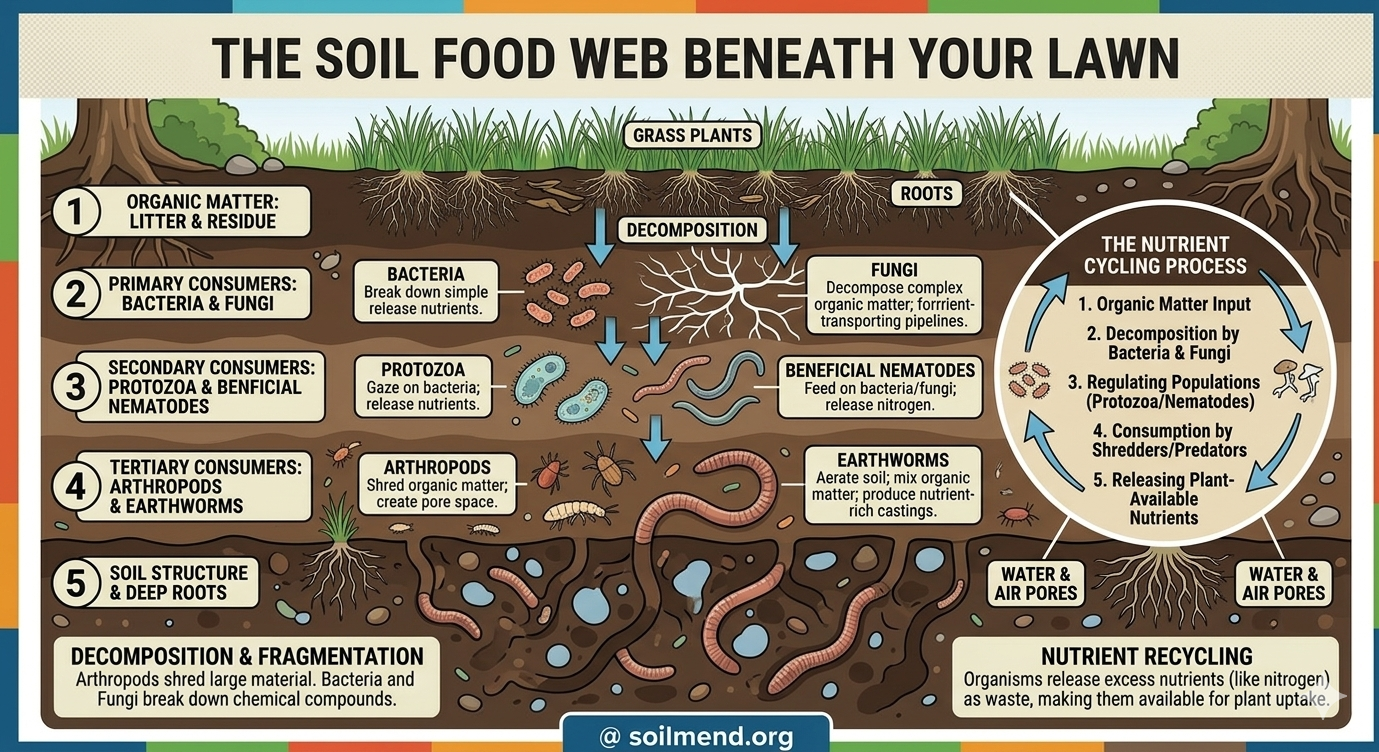
Microscopic single-celled organisms that are incredibly abundant — a teaspoon of healthy soil contains more bacteria than there are people on Earth. They break down simple sugars and fresh organic matter like grass clippings, rapidly releasing nitrogen that plants can use. Some specialized bacteria "fix" nitrogen directly from the air, making it available in soil without any fertilizer input.
Fungi form extensive networks of microscopic thread-like hyphae through the soil. They specialize in breaking down complex compounds that bacteria cannot handle — like the tough lignin in woody materials and old thatch. These fungal networks also act as subterranean pipelines, transporting nutrients and water directly to grass roots, greatly expanding the root system's effective reach.
Single-celled organisms much larger than bacteria, which they graze on voraciously. As they consume nutrient-rich bacteria, they excrete excess nitrogen in a form immediately accessible to plant roots. Protozoa are critical for the efficient cycling of nutrients — without them, nitrogen stays locked in bacterial bodies rather than reaching the grass above.
Microscopic unsegmented worms that are nearly invisible to the naked eye. In a healthy soil food web, the vast majority are beneficial. Some graze on bacteria, others on fungi, some even prey on other nematodes. Their feeding releases significant amounts of nitrogen through excretion — a key part of the natural fertilization process that operates without any human input.
A diverse group including mites, collembola (springtails), and small insects. They act as the ecosystem's "shredders" — chewing larger pieces of organic matter like dead leaves and thatch into smaller fragments. This dramatically increases surface area, making it easier for bacteria and fungi to complete decomposition. Without shredders, organic matter sits on the surface rather than feeding the soil.
Often called "nature's tillers" — and for good reason. Earthworms actively ingest soil and organic matter, mixing it through their digestive systems and excreting it as nutrient-rich castings. Their burrowing creates essential pore space, allowing air and water to penetrate deep to the roots. A healthy lawn has 200–400 earthworms per square meter. Their presence is the single best indicator of soil health.
Input: Organic matter (grass clippings, mulch, dead leaves, root exudates) falls onto or into the soil.
Primary decomposers go to work: Bacteria and fungi immediately begin breaking down this material, releasing initial nutrients.
Secondary consumers balance the system: Protozoa, beneficial nematodes, and arthropods feed on the bacteria and fungi, releasing nutrients in plant-available form.
Higher predators add complexity: Larger predatory nematodes and insects feed on secondary consumers — each layer adds biodiversity and resilience.
The ultimate benefit: At every stage, as organisms consume and excrete, essential nutrients — especially nitrogen, phosphorus, and sulfur — are released into the soil in forms grass roots can immediately absorb.
By promoting a living soil food web — through organic matter inputs, reduced chemical use, and minimizing soil disturbance — you allow this remarkable natural system to handle all the heavy lifting. The result is a lawn that fertilizes itself, aerates itself, and builds resilience against drought and disease over time. This is what "soil-first" means in practice.
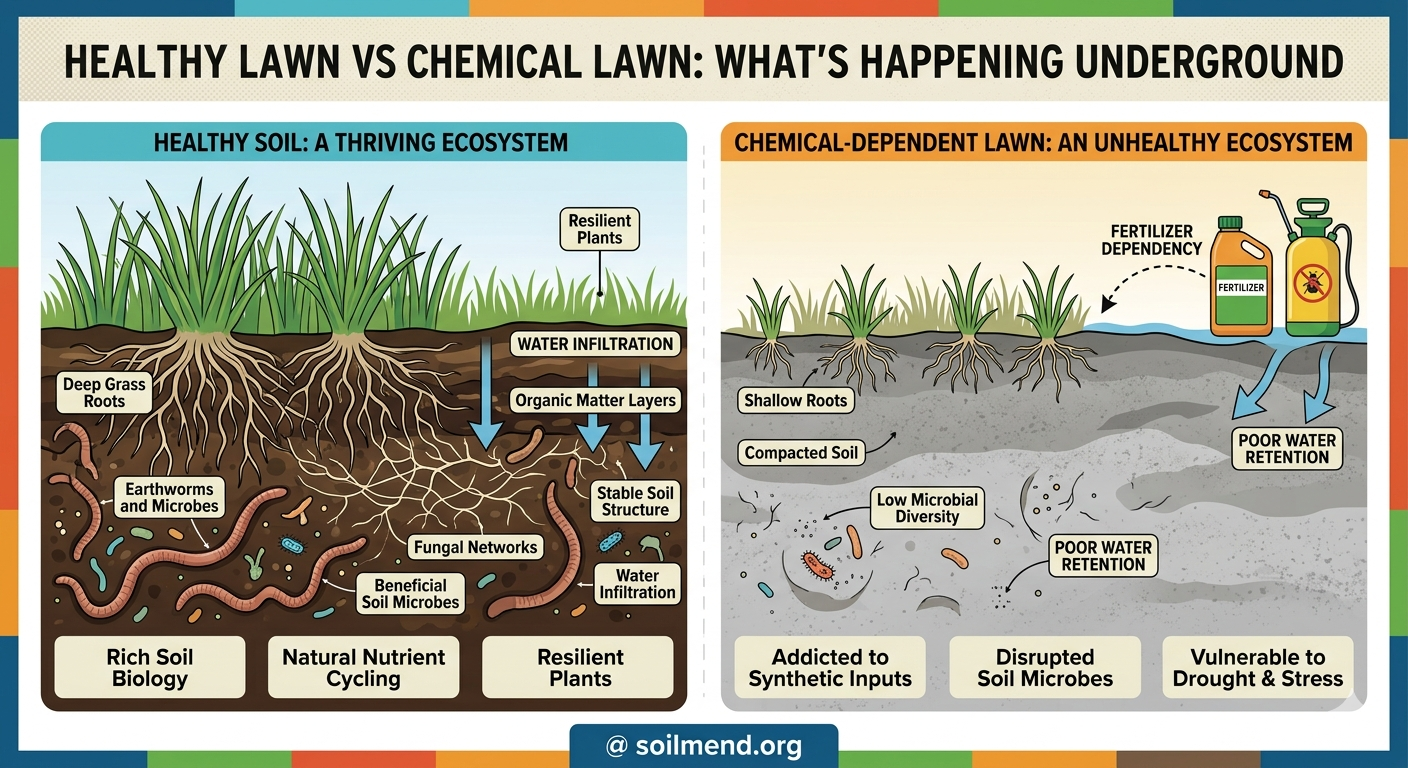
The difference between a thriving lawn and a chemically dependent one isn't visible above ground — it's entirely underground. This comparison shows exactly what is present (or absent) in the soil beneath each type of lawn, and why the biological approach produces genuinely resilient results.